







Why remote identification compliance has become a practical procurement issue
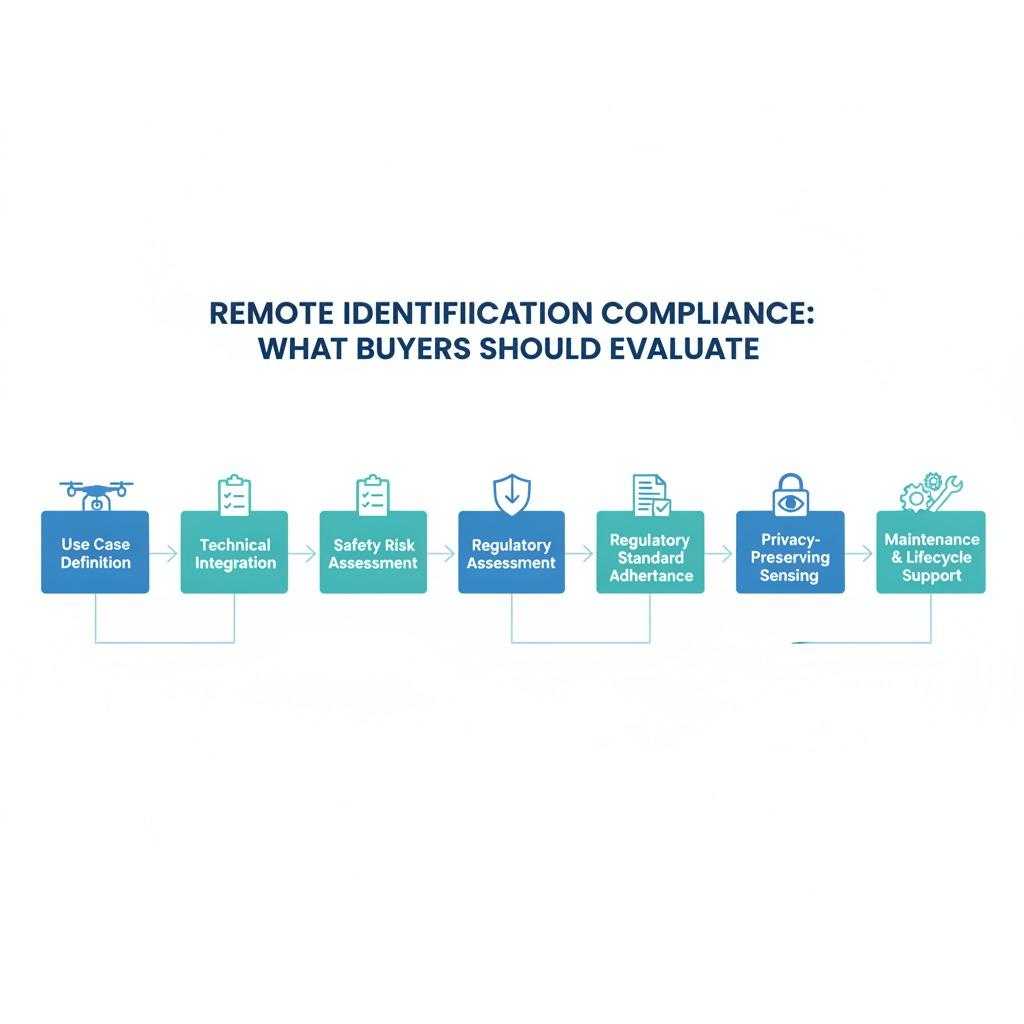
Remote identification compliance is no longer just a regulatory box to tick for drone operators, fleet managers, and product teams building unmanned systems. It has become a design, sourcing, and operations issue at the same time. If your organization buys, integrates, or deploys drones in regulated airspace, the question is not simply whether a unit can broadcast its identity. The harder question is whether the whole system supports safe operations, usable data, and regulatory standard adherence without creating new problems for pilots, maintenance teams, or nearby stakeholders.
That matters because the market has moved beyond hobby use. Commercial inspection, mapping, public safety, agricultural work, and infrastructure monitoring all depend on drones that can be identified, tracked, and evaluated in context. A product that technically satisfies a rule may still be awkward in the field if the identification module is unreliable, difficult to integrate, or incompatible with the operator’s broader safety risk assessment process.
What remote identification is actually solving
At a basic level, remote identification lets authorized parties identify a drone in operation and, in many implementations, connect that aircraft to location and flight details. For regulators, it supports airspace accountability. For operators, it can reduce uncertainty around who is flying and where. For manufacturers and sourcing teams, it creates a requirement that touches hardware, firmware, communications, and documentation.
That combination is why remote identification compliance should be treated as part of system architecture, not a last-minute add-on. A product team may be able to source a module that broadcasts identification data, but that still leaves questions about antenna placement, power draw, enclosure design, software update handling, and how the function behaves when the drone loses connectivity or is under environmental stress.
Key tradeoffs buyers need to think through
The compliance conversation usually sounds simple until it meets real operations. A fleet used for industrial inspection may need reliable identification in crowded sites, while a public safety team may be more concerned with visibility, traceability, and fast deployment. A manufacturer working toward detect-and-avoid for beyond visual line of sight (BVLOS) operations may be looking at remote identification as one layer inside a broader safety stack rather than as a stand-alone feature.
That is the right way to think about it. Remote identification can support operational transparency, but it does not replace detect-and-avoid for beyond visual line of sight (BVLOS), operator training, flight planning, or geofencing where applicable. Buyers sometimes overestimate what the function can do. It is a useful layer, not a shield.
A quick buyer’s comparison
Some teams need a full drone platform with built-in remote identification functions and update support. Others need only a module or subsystem that can be integrated into an existing airframe. The first path is often easier for standardization and regulatory standard adherence. The second may be better when the organization already has an approved platform or wants to preserve a specific payload configuration.
The practical difference is lifecycle control. If your fleet changes often, or if you expect software revisions, you should ask who owns updates, logging, and field support. A compliance feature that cannot be maintained cleanly becomes an operations burden very quickly.
Where safety risk assessment fits
Safety risk assessment is where product claims meet operating reality. A drone program should evaluate what happens if remote identification fails, becomes intermittent, or conflicts with other onboard systems. Does the aircraft remain flyable? Does the operator get a clear warning? Can the aircraft complete a mission safely, or should it return home?
These questions are especially important in mixed-fleet environments. Different aircraft may carry different communications hardware, battery systems, or payloads. The more variables you have, the more important it is to verify that remote identification works consistently across the fleet and under realistic conditions, not just in a controlled test bench.
Privacy-preserving sensing and the balance buyers have to strike
There is another side to the conversation that often gets overlooked: privacy-preserving sensing. As drone operations become more visible, organizations want compliant identification without exposing more operational data than necessary. That concern is understandable, especially for industrial sites, critical infrastructure, and security-sensitive operations.
The goal is not secrecy for its own sake. It is proportional disclosure. Buyers should ask what data is broadcast, who can receive it, how long it is retained, and whether the system supports the organization’s privacy policy as well as its flight rules. In some deployments, that distinction will matter as much as payload performance.
Common mistakes in procurement and program setup
One common mistake is treating compliance as a documentation exercise. Another is assuming the flight controller, communication module, and software stack will all behave well together without integration testing. A third is overlooking maintenance. If an update breaks a broadcast function, the problem may not appear until the next field deployment.
It is also easy to focus on the aircraft and ignore the workflow around it. Remote identification compliance affects registration processes, operator training, preflight checks, and incident response. If those pieces are not aligned, the program may be compliant on paper but brittle in practice.
What a sensible selection process looks like
For engineering and sourcing teams, the decision should start with use case, not with a feature sheet. Define the operating environment, the regulatory region, the mission profile, and the level of system integration required. Then ask the supplier for documentation that shows how the identification function is implemented, maintained, and verified.
From there, compare how each option fits into your larger safety and compliance framework. If BVLOS is part of the roadmap, remote identification should be evaluated alongside detect-and-avoid for beyond visual line of sight (BVLOS), not after it. If privacy is sensitive, make sure privacy-preserving sensing concerns are addressed early rather than debated once the aircraft is already selected.
Questions buyers should ask before committing
Does the system support the current operational region and likely future regulatory standard adherence needs? How are software updates handled? What happens if communications degrade? Can the solution be integrated into your existing fleet without a disruptive redesign? And who is responsible for keeping the compliance feature functional over the product life cycle?
Those questions are not academic. They are what separate a purchase that supports scale from one that creates avoidable rework.
Next step for engineering and sourcing teams
If you are evaluating a new drone platform, module, or fleet upgrade, treat remote identification compliance as part of the broader system decision. Build it into the technical review, the safety risk assessment, and the supplier qualification process. That approach takes a little more time up front, but it usually saves far more time than trying to patch compliance into an already-frozen design.