





The Saturation Point of Centralized Radar Coordination
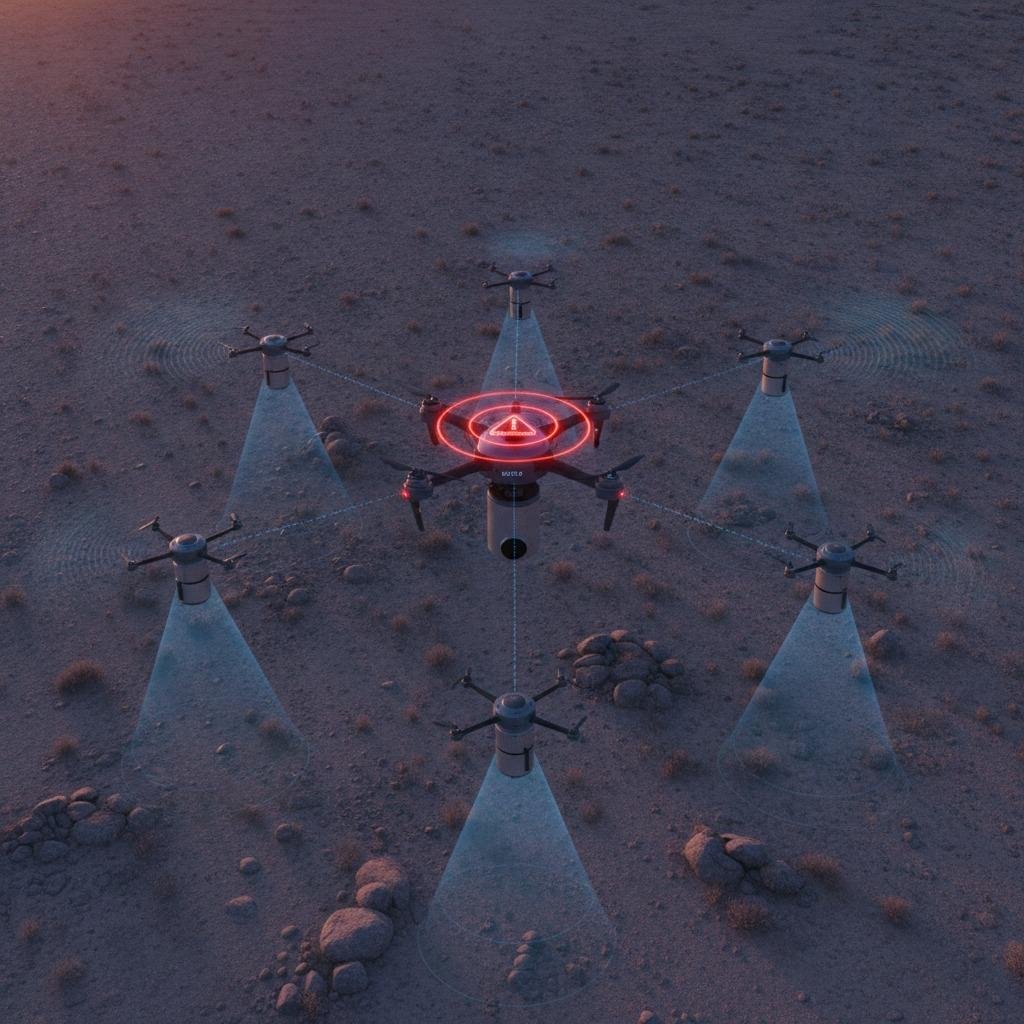
Coordinating multiple mobile radar nodes has traditionally relied on a straightforward architecture: individual sensor payloads transmit raw target returns to a central hub, which processes the cluster, handles beam scheduling, and feeds tracking vectors back down the line. In controlled environments with two or three aerial platforms, this approach works well enough. However, scaling an autonomous deployment past a handful of dynamic nodes exposes severe operational bottlenecks. Communication uplinks get overwhelmed by raw I/Q streaming, latencies climb past acceptable tracking thresholds, and mutual RF interference begins degrading detection baselines. Implementing self-organized radar sensing patterns offers a viable architectural way out of this saturation trap, shifting the burden of spatial coverage and spectrum sharing directly to the network edge.
For systems engineers and defense sourcing managers, moving away from centralized control is not merely a software upgrade. It represents a fundamental shift in how radar front-ends are specified, requiring agile transceivers capable of localized adaptation without waiting on instructions from a master processor.
The Technical Bottleneck: Mutual Interference and Latency Cascades
When multiple active radar sensors operate within close spatial and spectral proximity, they inevitably interfere with one another. Conventional methods rely on fixed frequency-division multiplexing (FDM) or hard-coded time slots. In dynamic environments, fixed allocations waste vast swaths of spectrum. A drone hovering over a featureless quadrant consumes the same bandwidth slice as a unit attempting to resolve high-priority micro-Doppler signatures across cluttered terrain.
Worse, latency escalates exponentially. If a coordinator node must ingest kinematic data, calculate optimal dwell times, and assign pulse repetition frequencies (PRF) to twenty separate platforms, tracking loops slip from milliseconds into full seconds. In rapid threat environments or GPS-denied swarm mapping, that latency means lost tracks and unmitigated RF blind spots.
Decentralizing the Waveform: Swarm Intelligence in Practice
The solution lies in deploying swarm intelligence for radar resource allocation. Rather than following an external timeline, each radar node operates as an autonomous agent that samples its local RF environment, monitors neighboring pulse activity, and adjusts its own transmission schedule based on local interaction rules.
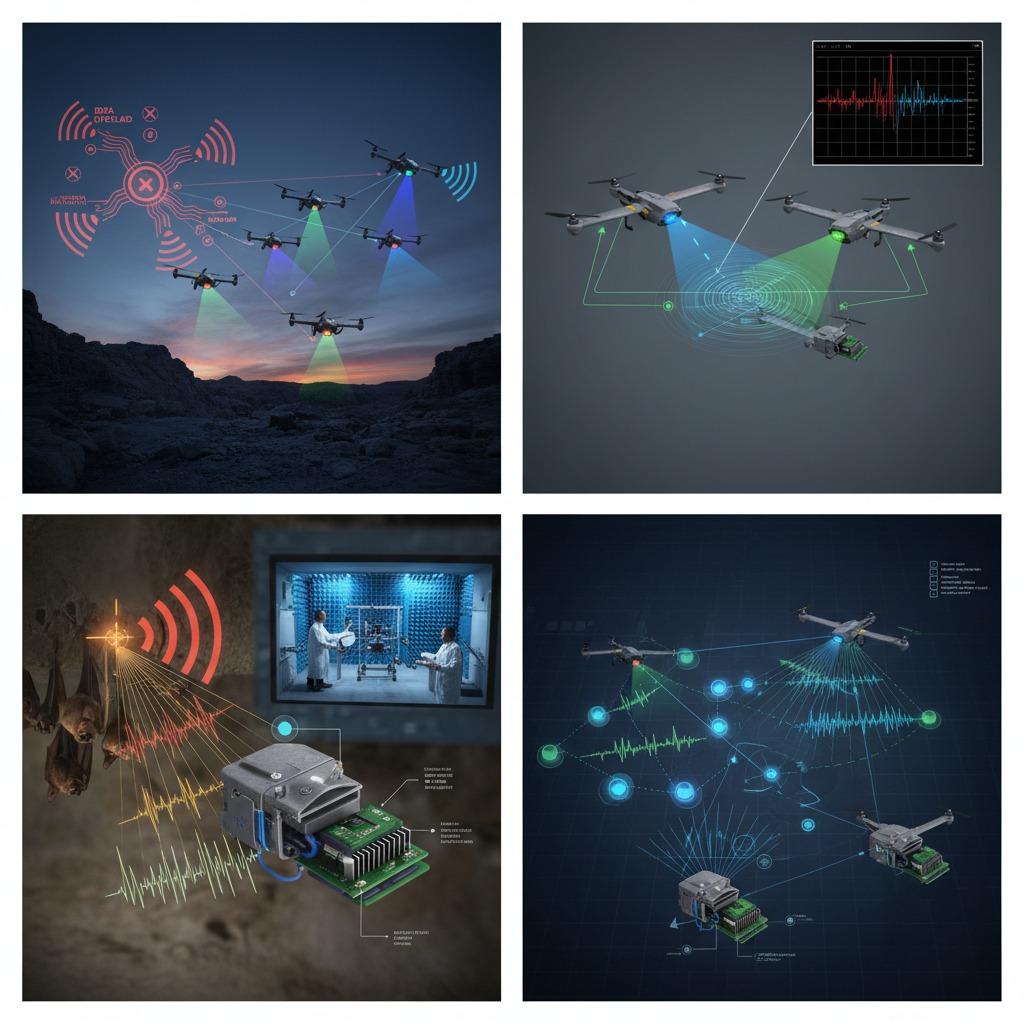
Instead of rigid scheduling, nodes employ distributed consensus algorithms running directly on payload FPGA/DSP hardware. If Node A detects elevated cross-platform noise on its primary operating sub-band, it shifts its carrier or modulates its pulse repetition interval (PRI) dynamically. This dynamic shift ripples across the cluster, yielding emergent sensing behavior in drone groups where the collective array continually optimizes its collective spatial awareness while driving mutual co-site interference toward zero.
Overcoming Spectrum Contention via Bio-Inspired Waveforms
Mimicking natural systems provides a proven template for dense RF coexistence. Echolocating bats operate in tight colonies without blinding each other's bio-sonar, achieved through continuous intra-pulse modulation and randomized frequency jitter. Translating this into RF payloads, bio-inspired radar waveform design replaces rigid linear FMCW chirps with non-linear, phase-coded, or chaotic waveforms that possess ultra-low cross-correlation profiles.
When combined with self-organized scheduling, these waveforms mean that even if two radar beams cross in space and time, the receivers treat the intersecting pulse as uncorrelated low-level noise rather than a false target. This eliminates the need for strict, centralized microsecond-level synchronization over external data links.
Enabling Collective Decision-Making with Radar Data
Deconfliction is only half the battle; the primary objective remains accurate target acquisition and situational tracking. When edge platforms govern their own sensing patterns, raw detection returns must be synthesized without choking network uplinks. This is where collective decision-making with radar data becomes critical.
Nodes do not stream uncompressed range-Doppler maps across the inter-agent datalink. Instead, they share sparse track hypotheses and spatial uncertainty matrices. If three peripheral units detect faint edge-of-envelope returns that do not meet single-node signal-to-noise thresholds, their shared uncertainty vectors trigger neighboring nodes to slew phased-array beams toward the coordinates of interest. Through this cooperative handoff, target confirmation occurs collectively at the edge, well before any centralized operator station receives a consolidated track report.
Engineering Trade-offs and Procurement Realities
While the operational advantages of self-organizing radar networks are compelling, engineering teams face significant integration hurdles that sourcing departments must factor into lead times and program budgets:
- SWaP-C Constraints: Running non-linear bio-inspired signal processing and local consensus algorithms demands substantially more on-node compute than standard matched-filter pipelines. Payloads require high-efficiency SoCs or RFSoC architectures that draw more DC power, directly impacting flight endurance.
- Non-Deterministic Verification: Defense and aerospace validation standards lean heavily on deterministic, repeatable behaviors. Proving that an emergent sensing configuration will comply with strict safety envelopes under all clutter conditions presents a testing challenge that static radar schedules never had to solve.
- Front-End Linearity: Dynamic waveform adaptation requires broadband power amplifiers (PAs) that maintain linearity across agile frequency sweeps, which often increases hardware component costs.
Implementation Checklist: Moving from Theory to Field Deployment
If your team is transitioning from fixed radar suites to self-organizing sensor arrays, evaluate your payload architecture against these key requirements before locking in requirements:
- Software-Defined Agility: Ensure RF transceivers support cycle-to-cycle waveform reconfigurability rather than relying on ASIC-locked chirps.
- Localized Datalink Layer: Datalinks must support ad-hoc mesh handshakes with deterministic packet prioritization for kinematic tracks rather than broadcast streaming.
- Benchmarking Emergence: Build hardware-in-the-loop (HIL) RF test environments capable of emulating dozens of interacting nodes simultaneously to validate edge algorithms before initiating flight trials.
Frequently Asked Questions
How do self-organized radar patterns handle severe RF jamming?
Because there is no centralized control hub, electronic warfare attacks cannot disable the network by taking out a single master node. When an active jammer illuminates a sector, local nodes detect the elevated noise floor, adapt their bio-inspired radar waveforms to burn through or skirt the jammed bands, and autonomously redirect unaffected nodes to gather track data from alternative angles.
Does this approach eliminate the need for inter-platform communication entirely?
No. While it eliminates the need to stream high-bandwidth raw sensor data, small low-latency track summaries and local state vectors still need to pass between nearby nodes to achieve effective spatial distribution and target handoffs.
Can legacy phased-array radars be upgraded for this capability?
Hardware retrofits depend heavily on the back-end processing architecture. If the beamformer and waveform generators are software-defined and backed by sufficiently capable edge processing (FPGA/GPU), self-organizing algorithms can often be deployed via firmware updates without replacing antenna apertures.
Next Steps for Development Teams
Transitioning toward self-organized radar topologies requires balancing processing autonomy against strict payload thermal limits. If your program is scoping next-generation distributed ISR or collaborative tracking suites, begin by modeling your multi-node RF clutter profiles using sparse waveform architectures. Contact our technical integration desk to review reference hardware designs, compute-to-SWaP trade studies, and simulation toolchains tailored to distributed radar payloads.