






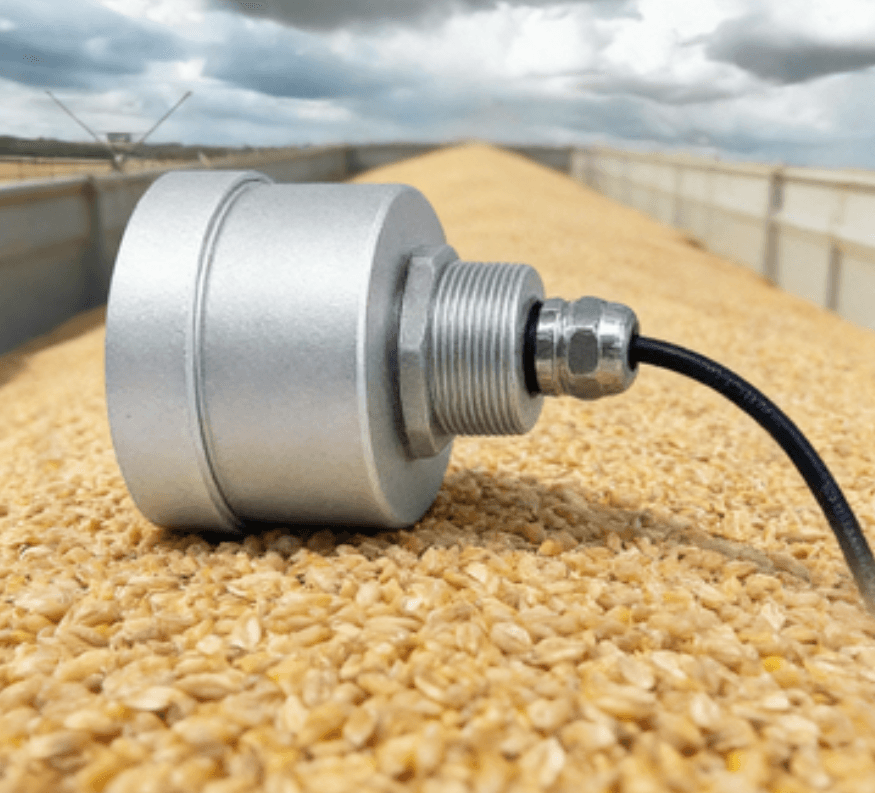
In industrial sensing, silos especially large-diameter bins and powder silos have long been a challenge for level measurement. Many purchasing managers and chief engineers face a familiar problem: datasheets promise ±3 mm accuracy, yet sensors begin fluctuating within months or fail completely.
The evolution of silo-level measurement is essentially a history of overcoming environmental interference. This article explains why industrial operators are increasingly turning to 80 GHz mmWave radar for reliable long-term performance.
1. On-Site Reality: “Can Measure” vs. “Reliable Long-Term”
Measuring successfully in a short test is simple. Sustaining accuracy across the entire grain storage cycle—intake, leveling, fumigation, and discharge—is far more difficult.
a) Dust Interference: Why Ultrasonic Fails
Grain handling generates high dust concentrations, especially with corn, wheat, or soybean meal. Ultrasonic sensors rely on sound waves traveling through air. Dust scatters and absorbs sound, causing signal loss. On-site, this shows up as repeated zero readings or maxed-out measurements.
b) Side Pull: The Risk for Guided Wave Radar
Guided wave radar (GWR) signals travel along a probe cable, reducing environmental interference. However, during grain discharge, lateral forces can bend the probe or detach the sensor from the silo roof. A broken probe can damage conveyors or downstream equipment.
c) Condensation and Buildup
Moisture and temperature changes cause condensation on sensor surfaces. Dust sticks to moisture, creating buildup that blocks low-frequency sensors or contact probes. This leads to blind zones and false readings, reducing reliability.
2. 80 GHz mmWave Radar: Physical Advantages for Stable Measurement
Why can engineers rely on 80 GHz radar for long-term accuracy? The benefits come from its physical and technical properties.
a) Narrow Beam for Precision
Conventional radars (6 GHz or 26 GHz) have wide beams (10–30°), which hit walls, ladders, and supports.
80 GHz radars have beams of ~3°, almost laser-like:
-
Precise targeting: Focuses on the grain surface.
-
Flexible installation: Works near silo walls or internal structures without interference.
b) Strong Penetration and Non-Contact Design
Millimeter waves penetrate dust effectively and measure the true grain surface. Being non-contact:
-
Zero mechanical risk: Avoids issues like side pull or probe bending.
-
Reduced maintenance: No wear, corrosion, or pressure on the sensor body, ensuring long-term stability.
3. Procurement Perspective: Focus on Long-Term Value
Higher upfront costs can deter decision-makers. However, considering the total operational impact shows clear advantages:
-
Maintenance savings: Traditional devices may require quarterly cleaning, adding up to the cost of a new 80 GHz sensor over three years.
-
Operational safety: False alarms can lead to silo overflows or empty-pump operation, causing losses many times the sensor cost.
“Dare to use long-term” is about reducing human intervention and freeing operators from frequent troubleshooting.
4. Silo Scenarios That Benefit Most from 80 GHz Radar
Industry experience shows three priority scenarios:
-
High or large-diameter silos: Long distance (up to 120 m) and complex internal structures.
-
Powder silos (soybean meal, feed): Heavy dust and uneven surfaces, where traditional sensors often fail.
-
Automated smart silos: 24/7 monitoring without frequent manual calibration.
Conclusion: Focus on Stability and Operational Certainty
In industrial applications, the most valuable metric is stability. Shifting from “can measure” to “dare to use long-term” reflects a move from short-term cost focus to long-term operational efficiency.
80 GHz mmWave radar represents the maintenance-free era of silo-level measurement. When alarms no longer trigger emergency trips and digital inventory curves remain stable, the true value of the technology is realized.
FAQ: 80 GHz mmWave Radar for Silo Applications
Q1: Can 80 GHz radar measure in high-dust environments?
A: Yes. Its narrow, high-frequency beam penetrates dust clouds and measures the true grain surface.
Q2: Is mechanical failure a concern?
A: No. Non-contact measurement eliminates risks from side pull or probe bending.
Q3: What is the maximum measurement distance?
A: Up to 120 m, suitable for tall or wide silos.
Q4: How often is maintenance required?
A: Minimal. Non-contact design and narrow beam reduce buildup and false readings.
Q5: Is it cost-effective despite the higher upfront price?
A: Yes. Lower maintenance, reduced labor, and avoided downtime often offset the initial cost within 2–3 years.
Q6: Which silo types are ideal for 80 GHz radar?
A: High silos, large-diameter bins, powder silos with heavy dust, and automated smart silos.