






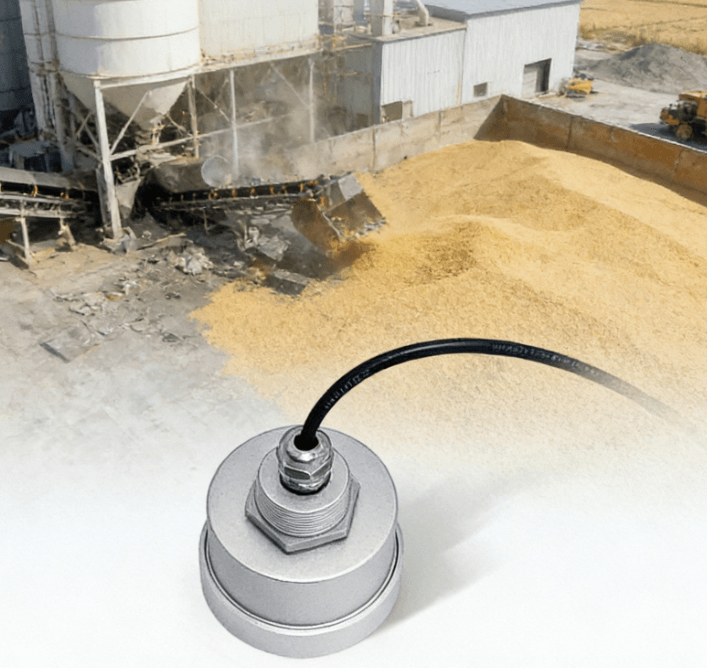
In grain storage operations across China, Southeast Asia, and Europe, silo level measurement plays a critical role in production safety. Yet level meters are often underestimated as minor sensing components. Improper selection can lead to production downtime, equipment damage, or even catastrophic dust explosions. Understanding and mitigating these safety risks is essential for modern silo management.
1. Contact Measurement Risks: Mechanical Fatigue and System Failures
Traditional contact-based level meters, including weighted tapes and guided-wave radar, have been widely used for their low initial cost. However, in large-capacity silos, they reveal critical vulnerabilities.
1.1 Hammer Collapse
Weighted tapes rely on a suspended metal weight to measure grain levels. In dynamic storage environments, the cable faces vertical tension and lateral impact from moving grain. Mechanical fatigue may cause cable breakage, resulting in a multi-kilogram weight falling—a phenomenon known as “hammer collapse.”
Consequences include conveyor damage, motor jams, and sparks that can trigger dust explosions. These secondary effects often far exceed the instrument’s original value.
1.2 Cable Breakage and Structural Damage
Guided-wave radar reduces moving parts but still relies on cables embedded in grain. During unloading, lateral stress can snap cables and transmit force to silo structures, potentially damaging seals or causing structural failures. For enterprise managers in China, Southeast Asia, and Europe, this represents hidden degradation of silo assets.
2. When Early Warnings Fail: Grain Voids and Hang-Ups
Accurate silo level measurement is essential for safety. Moisture changes, pressure, or fungal activity can create hidden voids beneath flat grain surfaces.
Contact-based meters may get stuck, and guided-wave radar may produce false signals due to material adhesion. Operators relying on inaccurate data risk entering silos with hidden voids, leading to collapse or suffocation accidents.
80 GHz mmWave radar offers high-precision, non-contact measurement. It detects subtle surface irregularities, providing early warnings for grain hang-ups and improving predictive maintenance.
3. Professional Selection and Compliance with EEAT Principles
Enterprises must move beyond low-cost procurement and follow EEAT principles (Expertise, Authoritativeness, Trustworthiness) for safety-critical decisions.
-
Compliance: Silos in hazardous zones must meet explosion-proof standards (Ex ia intrinsic safety, Ex db flameproof). Non-contact measurement devices inherently reduce mechanical friction and static accumulation, offering superior safety assurance.
-
Trustworthiness: Contact-based instruments require frequent maintenance and increase downtime, raising total cost of ownership (TCO). Non-contact meters, while initially more expensive, reduce manual inspections and occupational hazards, ensuring reliable long-term operation.
4. Strategic Shift: Achieving Zero Risk Through Non-Contact Measurement
Instrument selection is a strategic safety decision. Risks that can be mitigated with technology should not rely solely on management procedures.
Management Recommendations:
-
Technology Upgrade: Use non-contact, high-frequency, explosion-proof level meters for all new or retrofitted silos.
-
Asset Protection: Implement meters with self-diagnostics, integrating data into safety monitoring platforms for predictive maintenance.
-
Value Assessment: Consider equipment safety and downstream machinery protection in cost evaluations. Advanced instruments eliminate hammer collapse and cable breakage risks.
For grain storage operations in China, Southeast Asia, and Europe, these measures protect both assets and personnel while ensuring compliance with regional safety regulations.
FAQ: Silo Level Measurement Safety & Non-Contact Solutions
Q1: Why are contact-based level meters risky in large silos?
A1: Contact meters, such as weighted tapes and guided-wave radar, are prone to mechanical fatigue and lateral stress, which can cause hammer collapse, cable breakage, and safety risks, including dust explosions.
Q2: How does 80 GHz mmWave radar enhance silo safety?
A2: Non-contact measurement with mmWave radar detects subtle grain surface changes and hang-ups, reduces false readings, and lowers manual inspection risks, enabling predictive maintenance.
Q3: Are non-contact meters compliant with explosion-proof standards?
A3: Yes. They typically meet Ex ia or Ex db certifications and are suitable for silos in hazardous zones in China, Southeast Asia, and Europe.
Q4: What is the total cost advantage of non-contact meters?
A4: Although initial investment is higher, they reduce maintenance frequency, downtime, occupational hazards, and downstream machinery damage—resulting in lower TCO over time.
Q5: How should enterprises evaluate level meter selection?
A5: Evaluate based on compliance, EEAT principles, predictive maintenance capability, long-term reliability, and overall risk mitigation—not just purchase price.