






Introduction
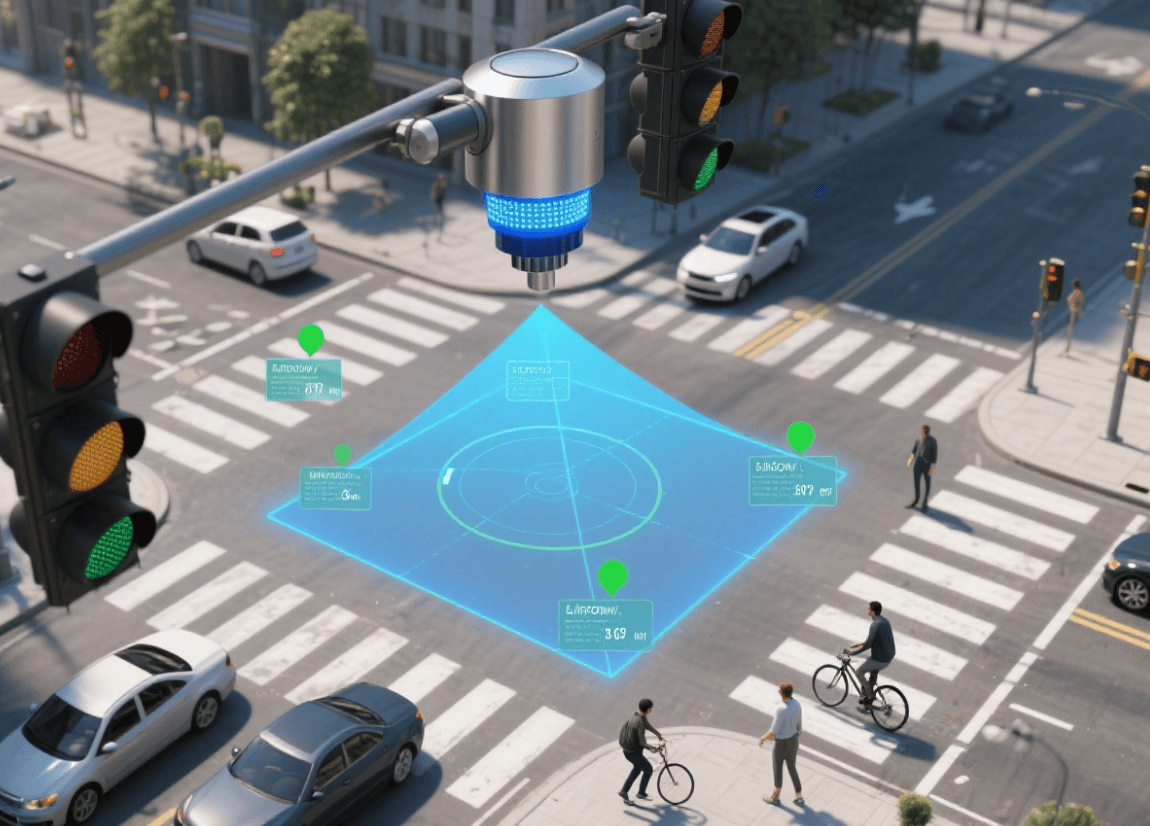
Urban intersections are some of the most complex and high-risk areas in traffic networks. Traditional monitoring methods, such as cameras and inductive loops, often struggle under low visibility, heavy rain, or dense traffic. Millimeter-wave (mmWave) radar technology offers a robust solution, providing precise multi-target detection, real-time tracking, and reliable performance in adverse conditions. By deploying mmWave radar at intersections, cities can improve traffic efficiency, reduce congestion, and enhance pedestrian and vehicle safety.
Multi-Target Detection at Intersections
Busy intersections often involve vehicles, bicycles, and pedestrians appearing simultaneously, sometimes partially occluding one another. Linpowave’s high-resolution mmWave radar addresses these challenges with advanced detection and tracking algorithms.
Technical highlights:
-
Multiple Object Tracking (MOT) Algorithms: Processes radar point cloud data to identify, track, and predict trajectories of all moving objects. Unique IDs maintain continuity even when objects temporarily overlap.
-
Dynamic Threshold Adjustment: Varying reflection strengths from vehicles, cyclists, and pedestrians require adaptive thresholds to prevent weaker targets from being missed.
-
Reflection Filtering: Urban intersections include reflective surfaces such as traffic signs and nearby buildings. Advanced filtering distinguishes moving targets from static reflections, reducing false detections.
Dynamic Signal Optimization
Linpowave radar enables intersections to dynamically optimize traffic signal timing:
-
Queue Length Estimation: Measures vehicle spacing and positions to estimate waiting vehicles at each approach.
-
Adaptive Signal Timing: Integration with traffic controllers allows green light durations and phase sequences to adjust in real time, reducing congestion and idle times.
-
Emergency Vehicle Priority: Detects approaching emergency vehicles, triggering signal preemption to clear their path.
Performance in Adverse Conditions
Unlike camera-based systems, mmWave radar remains reliable under low light, fog, or rain. Deployment considerations include:
-
Environmental Calibration: Adjusting radar sensitivity ensures detection accuracy during rain or temperature variations.
-
Height and Tilt Optimization: Proper installation ensures full coverage and minimal blind spots, critical in intersections with multiple lanes and complex layouts.
Integration with Existing Infrastructure
Implementing radar at intersections requires careful integration with cameras, traffic lights, and traffic management systems:
-
Time Synchronization: Aligning radar data with cameras and controllers ensures accurate decision-making.
-
Data Fusion: Combining radar and video data enhances object classification and reduces false positives.
-
Latency Management: Real-time processing is essential. Edge computing can handle radar data locally before transmitting key metrics to central systems.
Linpowave Radar Solutions
Linpowave’s LPR-300 series mmWave radar offers:
-
High-resolution detection of vehicles, cyclists, and pedestrians up to 300 meters
-
Multi-target tracking with minimal latency for real-time traffic optimization
-
Robust performance under rain, fog, and nighttime conditions
-
Compact design for easy integration into existing intersections
Case Study
A mid-sized city deployed Linpowave radar at a busy downtown intersection. Within a few weeks:
-
Average vehicle waiting time decreased by 18%
-
Pedestrian-vehicle conflict incidents decreased by 23%
-
Reliable detection was maintained in heavy rain and low-light conditions, outperforming previous camera-based systems
Future Outlook
As connected and autonomous vehicles become more common, intersections equipped with mmWave radar can serve as communication hubs, sharing traffic and hazard information with approaching vehicles. Integrating radar with AI analytics and V2X communication will further enhance urban mobility, enabling truly intelligent and responsive traffic systems.
Conclusion
Millimeter-wave radar is transforming intersection management by providing accurate multi-target detection, dynamic signal optimization, and reliable performance in adverse conditions. Linpowave radar solutions provide the performance, scalability, and robustness needed for modern smart cities, paving the way for safer, more efficient intersections.