






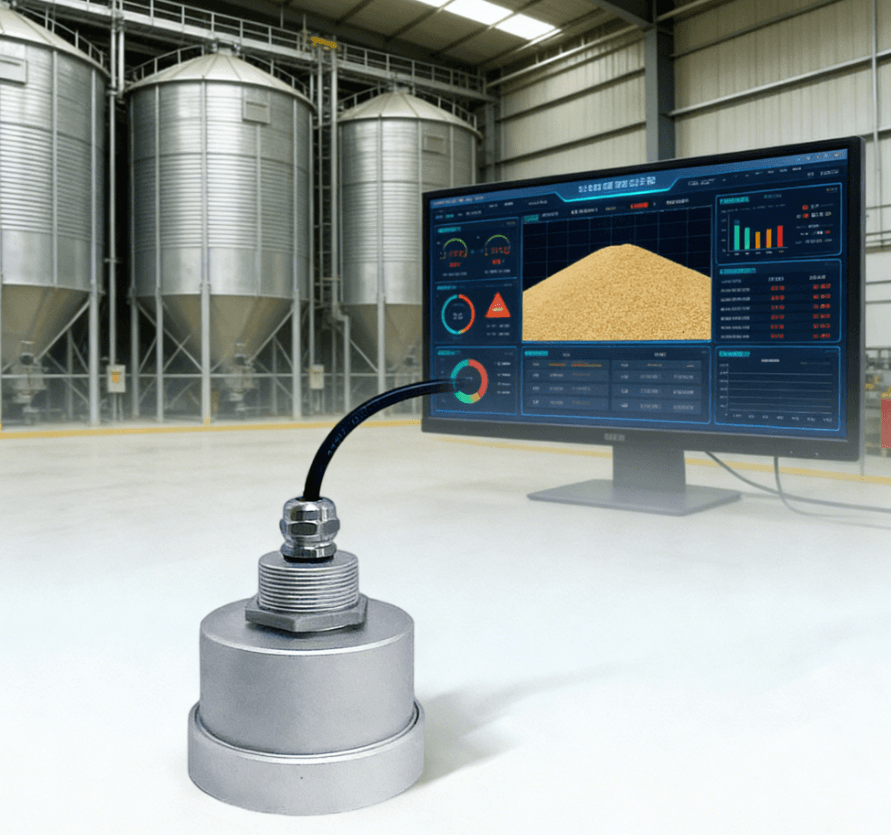
In the era of digital transformation, the grain storage industry is making a remarkable leap from “experience-based management” to “data-driven operations.” However, many silo operators find a critical challenge after deploying costly cloud platforms and smart dashboards: data mismatch.
Warehouse indicators may show available capacity, while the silo is already empty. System prompts for rotation may arrive, but inspection reveals damped grain. These issues point to a core pain point in digital transformation—the failure of the perception layer. As a manufacturer of millimeter wave radar, we argue that the success of a smart silo is not defined by complex algorithms but by the robustness of underlying sensing devices—millimeter wave silo level sensors.
1. The “Dirty Data” Trap in Digital Transformation: The Cost of GIGO
In IT, there is a well-known principle: GIGO (Garbage In, Garbage Out). If the underlying sensors cannot provide accurate, real-time measurements, all higher-level AI predictions, financial reconciliations, and operational scheduling become a castle built on sand.
Why Traditional Sensors Fall Short
Traditional ultrasonic sensors or low-frequency radars (below 26 GHz) struggle in extreme silo environments. Dust generated during grain intake, complex concrete support structures, or irregular grain surfaces scatter signals and produce false echoes, leading to unreliable readings.
Business Risks of “Blurred Data”
Even a 1% measurement error in a 10,000-ton silo can represent hundreds of tons of “invisible assets.” The consequences include:
-
Financial blind spots: Banks hesitate to approve warehouse receipt financing due to unreliable perception data.
-
Delayed operational decisions: Rotation or dispatch instructions may lag, increasing the risk of spoilage or grain degradation.
2. 80 GHz Millimeter Wave Radar: A Leap in Inventory Resolution
Addressing the dirty data problem requires high-frequency sensing at the physical level. 80 GHz radar is engineered for precisely this challenge.
Extremely Narrow Beam: Precision Like a Surgical Knife
Unlike low-frequency radars with broad beams, 80 GHz radars can reduce beam angles to about 3°. Within a narrow silo, the radar can avoid obstacles like wall deposits, support beams, and ladders, focusing directly on the grain surface. This precision increases measurement accuracy from centimeters to millimeters, ensuring pure echo signals for reliable inventory data.
Penetrating Dust and Steam: All-Weather “X-Ray Vision”
Grain handling produces dense dust that is problematic for optical or ultrasonic sensors. Millimeter wave radar can penetrate dust, water vapor, and steam, providing uninterrupted 24/7 monitoring. High-frequency sensing ensures the data chain remains intact, even in extreme conditions.
Real-Time Dynamic Profiling: Accurate Flow Reconciliation
With high-sampling FSK or FMCW modulation, millimeter wave radar not only measures points but also performs real-time surface fitting. When grain enters at hundreds of tons per hour, the radar captures instantaneous surface rise rates and cross-validates with flow meters, instantly detecting missing or misappropriated grain.
3. From Measuring Quantity to Predicting Grain Health: Elevating Data Assets
The true value of a smart silo lies in empowering inventory finance and precise scheduling.
Anomaly Algorithms: Invisible Guardians of Grain Health
Grain may clump or collapse due to localized heating or moisture before temperature sensors react. Our millimeter wave radar, combined with level anomaly algorithms, can detect unusual surface subsidence or bulges, predicting spoilage risks in advance.
Remote Cluster Control: A Digital Nervous System
Data from individual silos gains power when networked. Using the RS485 bus or industrial-grade LoRa, radar data from multiple silos can be integrated into edge gateways. Decision-makers at headquarters can view real-time water-level maps across regions or even nationwide, optimizing dispatch plans according to market prices.
Enabling Inventory Finance: Turning Grain into Liquid Assets
Accurate, tamper-proof measurements provide a foundation for warehouse receipt financing. With high-precision radar, silos become “transparent banks,” lowering supervision costs and increasing financing capacity for enterprises.
4. Future Trends: Integrating Millimeter Wave Radar with 3D Level Scanning
Single-point measurements are evolving into full-space perception. Future silo systems will feature multi-head radar arrays, generating 3D digital twins of grain surfaces. Sloped, concave, or stacked grain can be measured volumetrically, eliminating blind spots in asset monitoring.
Conclusion: The Depth of Perception Determines the Height of Smart Transformation
Smart silo initiatives should not be superficial “window dressing” but grounded in robust sensing infrastructure. Only when the perception layer is high-frequency, precise, and intelligent can digital transformation deliver tangible decision-making benefits.
At a time when grain security is a national priority, choosing a high-performance millimeter wave level sensor is more than a technical upgrade—it is a commitment to every ton of stored grain.
FAQ: High-Frequency Sensing in Smart Silos
Q1: Why is 80 GHz millimeter wave radar better than traditional sensors?
A1: 80 GHz radar offers narrow beam angles, high resolution, and the ability to penetrate dust and steam. This ensures accurate silo level measurement even in extreme conditions.
Q2: Can millimeter wave radar detect grain spoilage?
A2: Yes. By monitoring subtle anomalies in grain surface levels, radar can predict potential clumping or moisture problems before temperature sensors respond.
Q3: How does high-frequency sensing improve inventory finance?
A3: Accurate, tamper-proof radar measurements provide reliable, real-time data for banks, enabling warehouse receipt financing and increasing enterprise liquidity.
Q4: Is 3D scanning with radar available now?
A4: Multi-head millimeter wave radar arrays are emerging, allowing volumetric calculations and digital twin creation for precise inventory management.