






Overcoming Detection Challenges with Millimeter-wave (mmWave) Sensing

In today's fast-paced world of IoT and smart devices, one major problem is the limited accuracy and range of traditional sensing technologies. Millimeter-wave (mmWave) sensing emerges as a powerful solution, enabling precise detection in environments cluttered with obstacles or requiring high-resolution imaging. This technology operates in the millimeter-wave frequency bands, offering superior resolution compared to lower-frequency alternatives, which often struggle with interference and poor detail in applications like automotive safety, healthcare monitoring, and industrial automation.
Understanding the Core Problem in Sensing Applications
Conventional sensors, such as ultrasonic or infrared systems, face significant limitations when it comes to detecting small objects or operating in adverse conditions like fog, dust, or rain. These issues can lead to unreliable data in critical scenarios, potentially compromising safety and efficiency. For instance, in autonomous vehicles, inaccurate sensing might result in delayed responses to pedestrians or obstacles. Millimeter-wave (mmWave) sensing addresses this by leveraging short wavelengths that allow for fine-grained resolution, making it ideal for non-contact vital sign monitoring or gesture recognition without the privacy concerns of camera-based systems.
FMCW Radar Architecture: A Key Solution for Reliable Detection
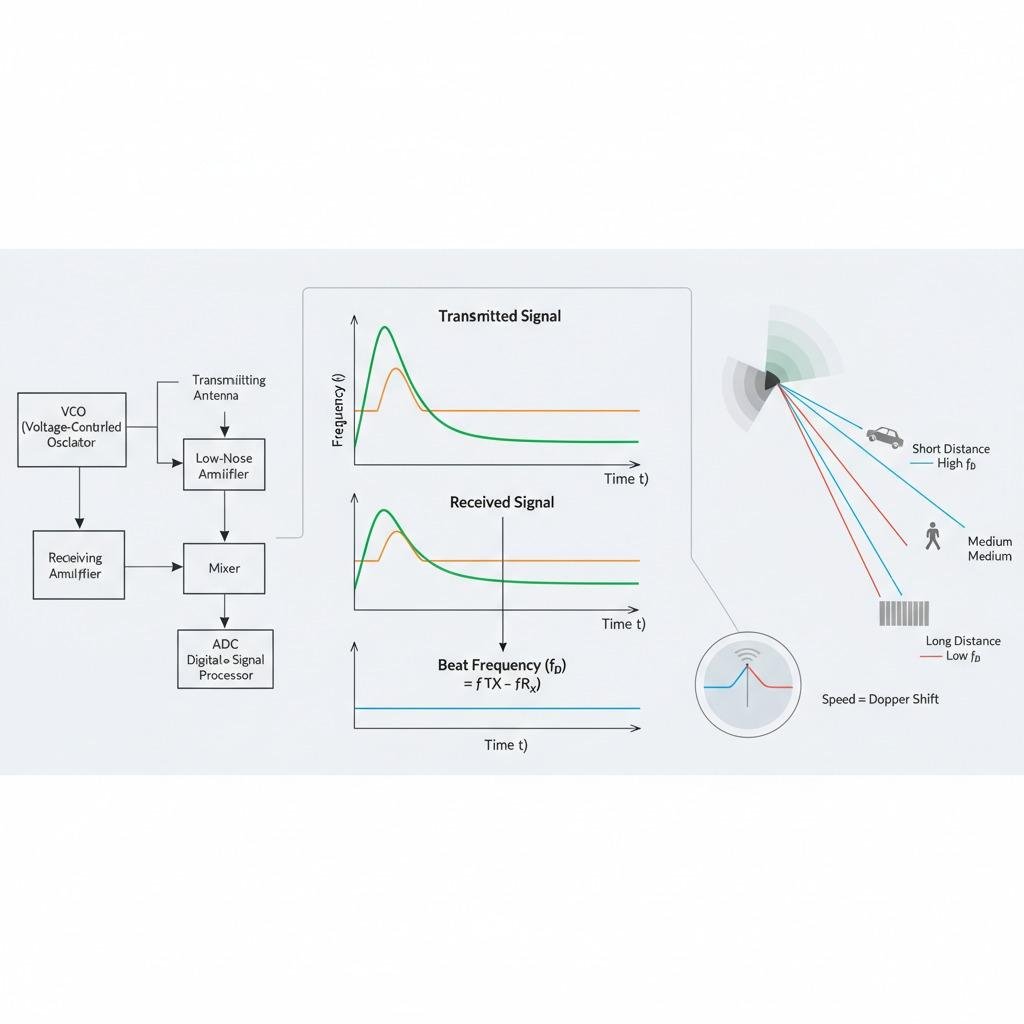
To tackle the precision gap, Frequency Modulated Continuous Wave (FMCW) radar architecture stands out within mmWave sensing frameworks. This approach modulates the frequency of the transmitted signal over time, enabling the measurement of both distance and velocity with high accuracy. Unlike pulsed radar, FMCW reduces bandwidth requirements while maintaining excellent range resolution, solving the problem of signal processing complexity in compact devices. By integrating FMCW radar architecture into mmWave systems, engineers can achieve robust performance in dynamic environments, such as security surveillance where quick threat identification is essential.
Enhancing mmWave Capabilities with MIMO Antenna Array
Another challenge in mmWave sensing is achieving wide coverage without sacrificing resolution. MIMO antenna array technology provides an effective solution by using multiple input multiple output configurations to improve spatial awareness. This setup allows the system to transmit and receive signals from various angles simultaneously, effectively multiplying the virtual antenna elements for better imaging. In practical terms, a MIMO antenna array in mmWave sensing can detect multiple targets in cluttered spaces, addressing issues like multipath interference in urban settings or warehouses. This not only boosts accuracy but also extends the operational range, making it a go-to for advanced robotics and smart home applications.
Phased Array Beam Steering for Adaptive Sensing
Directivity control poses yet another hurdle in mmWave sensing, where fixed beams might miss subtle movements or distant objects. Phased array beam steering resolves this by electronically adjusting the phase of signals across antenna elements to direct the beam precisely where needed. This dynamic focusing eliminates the need for mechanical parts, reducing size and power consumption while enabling real-time adaptation to changing scenes. For example, in healthcare, phased array beam steering in mmWave devices can track patient movements accurately during remote monitoring, mitigating the risks of overlooked anomalies in vital signs detection.
Role of RF Integrated Circuits (RFIC) in Streamlining mmWave Solutions
Finally, the integration of components remains a bottleneck, often leading to bulky and inefficient systems. RF integrated circuits (RFIC) offer a compact solution by combining amplifiers, mixers, and oscillators on a single chip tailored for mmWave frequencies. This miniaturization enhances the overall efficiency of mmWave sensing setups, solving power and cost constraints in consumer electronics. With RFIC advancements, devices become more affordable and scalable, paving the way for widespread adoption in areas like 5G-enabled smart cities or wearable health tech.
By adopting these mmWave sensing technologies—FMCW radar architecture, MIMO antenna array, phased array beam steering, and RFIC—industries can overcome longstanding detection challenges, ushering in a new era of reliable, high-performance sensing solutions.